S&w 38 Double Action Safety Hammerless Review Forgotten Weapons
| Due south | |
|---|---|
| Due south south ſ | |
| (See below) | |
 | |
| Usage | |
| Writing system | Latin script |
| Type | Alphabetic and Logographic |
| Language of origin | Latin language |
| Phonetic usage |
|
| Unicode codepoint | U+0053, U+0073 |
| Alphabetical position | 19 |
| History | |
| Development |
|
| Time period | ~-700 to nowadays |
| Descendants |
|
| Sisters |
|
| Variations | (Encounter below) |
| Other | |
| Other letters unremarkably used with | s(x), sh, sz |


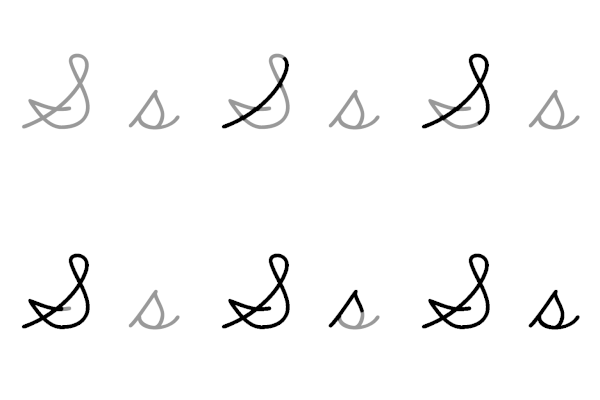
S, or s, is the nineteenth letter in the Mod English alphabet and the ISO basic Latin alphabet. Its name in English is ess [1] (pronounced ), plural esses.[2]
History
Origin
Northwest Semitic šîn represented a voiceless postalveolar fricative /ʃ/ (equally in 'ship'). It originated nigh likely as a pictogram of a tooth ( שנא ) and represented the phoneme /ʃ/ via the acrophonic principle.[3]
Ancient Greek did not have a /ʃ/ phoneme, so the derived Greek letter sigma ( Σ ) came to correspond the voiceless alveolar sibilant /s/. While the alphabetic character shape Σ continues Phoenician šîn, its name sigma is taken from the letter samekh, while the shape and position of samekh but name of šîn is connected in the xi.[ commendation needed ] Within Greek, the proper noun of sigma was influenced by its association with the Greek word σίζω (earlier *sigj- ) "to hiss". The original name of the letter "sigma" may have been san, but due to the complicated early on history of the Greek epichoric alphabets, "san" came to be identified as a separate alphabetic character, Ϻ.[4] Herodotus reports that "San" was the name given past the Dorians to the same letter called "Sigma" by the Ionians.[v]
The Western Greek alphabet used in Cumae was adopted by the Etruscans and Latins in the seventh century BC, over the following centuries developing into a range of Old Italic alphabets including the Etruscan alphabet and the early Latin alphabet. In Etruscan, the value /south/ of Greek sigma (𐌔) was maintained, while san (𐌑) represented a separate phoneme, most probable /ʃ/ (transliterated as ś). The early Latin alphabet adopted sigma, just not san, every bit Old Latin did not accept a /ʃ/ phoneme.
The shape of Latin Southward arises from Greek Σ by dropping one out of the four strokes of that letter. The (angular) S-shape equanimous of three strokes existed equally a variant of the 4-stroke letter of the alphabet Σ already in the epigraphy in Western Greek alphabets, and the three and four strokes variants existed alongside one another in the classical Etruscan alphabet. In other Italic alphabets (Venetic, Lepontic), the letter of the alphabet could be represented as a zig-zagging line of whatever number between three and six strokes.
The Italic letter was also adopted into Elder Futhark, as Sowilō (ᛊ), and appears with 4 to eight strokes in the primeval runic inscriptions, but is occasionally reduced to three strokes (ᛋ) from the later 5th century, and appears regularly with 3 strokes in Younger Futhark.
Long s

Late medieval High german script (Swabian bastarda, dated 1496) illustrating the use of long and round s: prieſters tochter ("priest's daughter").
The minuscule form ſ, called the long due south, developed in the early medieval period, inside the Visigothic and Carolingian hands, with predecessors in the one-half-uncial and cursive scripts of Late Artifact. Information technology remained standard in western writing throughout the medieval period and was adopted in early on press with movable types. Information technology existed aslope minuscule "round" or "short" s, which was at the time only used at the cease of words.
In most western orthographies, the ſ gradually fell out of utilize during the second half of the 18th century, although information technology remained in occasional use into the 19th century. In Spain, the change was mainly accomplished betwixt the years 1760 and 1766. In France, the change occurred between 1782 and 1793. Printers in the Us stopped using the long s betwixt 1795 and 1810. In English orthography, the London printer John Bong (1745–1831) pioneered the change. His edition of Shakespeare, in 1785, was advertised with the claim that he "ventured to depart from the common mode by rejecting the long 'ſ' in favor of the circular one, as being less liable to error....."[six] The Times of London fabricated the switch from the long to the short s with its issue of 10 September 1803. Encyclopædia Britannica's fifth edition, completed in 1817, was the last edition to apply the long s.
In German orthography, long s was retained in Fraktur (Schwabacher) blazon as well as in standard cursive (Sütterlin) well into the 20th century, and was officially abolished in 1941.[seven] The ligature of ſs (or ſz) was retained, however, giving ascent to the Eszett, ß in contemporary German language orthography.
Use in writing systems
The letter ⟨s⟩ is the 7th most common alphabetic character in English and the third-most common consonant afterwards ⟨t⟩ and ⟨n⟩.[viii] It is the most common letter for the starting time letter of a give-and-take in the English language.[9] [10]
In English and several other languages, primarily Western Romance ones like Spanish and French, final ⟨s⟩ is the usual mark of plural nouns. It is the regular ending of English third person present tense verbs.
⟨s⟩ represents the voiceless alveolar or voiceless dental sibilant /s/ in well-nigh languages as well as in the International Phonetic Alphabet. It also commonly represents the voiced alveolar or voiced dental sibilant /z/, as in Portuguese mesa (table) or English 'rose' and 'bands', or it may correspond the voiceless palato-alveolar fricative [ʃ], as in most Portuguese dialects when syllable-finally, in Hungarian, in German (before ⟨p⟩, ⟨t⟩) and some English language words as 'saccharide', since yod-coalescence became a dominant feature, and [ʒ], every bit in English 'mensurate' (also because of yod-coalescence), European Portuguese Islão (Islam) or, in many sociolects of Brazilian Portuguese, esdrúxulo (proparoxytone) in some Andalusian dialects, it merged with Peninsular Spanish ⟨c⟩ and ⟨z⟩ and is now pronounced [θ]. In some English words of French origin, the letter ⟨s⟩ is silent, as in 'island' or 'debris'. In Turkmen, ⟨s⟩ represents [θ].
The ⟨sh⟩ digraph for English /ʃ/ arises in Center English (alongside ⟨sch⟩), replacing the One-time English language ⟨sc⟩ digraph. Similarly, Old German ⟨sc⟩ was replaced by ⟨sch⟩ in Early Modernistic German language orthography.
- ſ : Latin letter long s, an obsolete variant of s
- ẜ ẝ : Diverse forms of long south were used for medieval scribal abbreviations[xi]
- ẞ ß : German language Eszett or "abrupt S", derived from a ligature of long due south followed by either due south or z
- S with diacritics: Ś ś Ṡ ṡ ẛ Ṩ ṩ Ṥ ṥ Ṣ ṣ S̩ s̩ Ꞩ ꞩ Ꟊꟊ[12] Ŝ ŝ Ṧ ṧ Š š Ş ş Ș ș S̈ s̈ ᶊ Ȿ ȿ ᵴ[thirteen] ᶳ[14]
- ₛ : Subscript small south was used in the Uralic Phonetic Alphabet prior to its formal standardization in 1902[fifteen]
- ˢ : Modifier letter small s is used for phonetic transcription
- ꜱ : Small uppercase Due south was used in the Icelandic First Grammatical Treatise to mark gemination[eleven]
- Ʂ ʂ : Due south with claw, used for writing Standard mandarin Chinese using the early draft version of pinyin romanization during the mid-1950s[16]
- Ƨ ƨ : Latin letter reversed South (used in Zhuang transliteration)
- IPA-specific symbols related to Southward: ʃ ɧ [ citation needed ] ʂ
- Ꞅ ꞅ : Insular Southward
Derived signs, symbols, and abbreviations

- $ : Dollar sign
- ₷ : Spesmilo
- § : Section sign
- ℠ : Service marking symbol
- ∫ : Integral symbol, curt for summation (derived from long south)
Ancestors and siblings in other alphabets
- 𐤔 : Semitic letter Shin, from which the following symbols originally derive
- Ս : Armenian letter Se
Computing codes
| Preview | S | s | ||
|---|---|---|---|---|
| Unicode proper noun | LATIN CAPITAL Letter S | LATIN Pocket-size LETTER S | ||
| Encodings | decimal | hex | dec | hex |
| Unicode | 83 | U+0053 | 115 | U+0073 |
| UTF-8 | 83 | 53 | 115 | 73 |
| Numeric character reference | S | S | s | s |
| ASCII one | 83 | 53 | 115 | 73 |
- one Also for encodings based on ASCII, including the DOS, Windows, ISO-8859 and Macintosh families of encodings.
Other representations
Chemical science
The letter Due south is used:
- In a chemical formula to correspond sulfur. For instance, And so
2 is sulfur dioxide. - In the preferred IUPAC proper name for a chemical, to signal a specific enantiomer. For example, "(S)-2-(4-Chloro-ii-methylphenoxy)propanoic acrid" is one of the enantiomers of mecoprop.
See also
- Cool S
- Meet about Ⓢ in Enclosed Alphanumerics
References
- ^ Spelled 'es'- in chemical compound words
- ^ "Due south", Oxford English language Dictionary, 2nd edition (1989); Merriam-Webster's Third New International Dictionary of the English Language, Entire (1993); "ess," op. cit.
- ^ "corresponds etymologically (in role, at least) to original Semitic ṯ (th), which was pronounced s in Southward Canaanite" Albright, West. F., "The Early Alphabetic Inscriptions from Sinai and their Decipherment," Bulletin of the American Schools of Oriental Research 110 (1948), p. 15. The interpretation as "tooth" is now prevalent, but not entirely certain. The Encyclopaedia Judaica of 1972 reported that the letter represented a "composite bow".
- ^ Woodard, Roger D. (2006). "Alphabet". In Wilson, Nigel Guy. Encyclopedia of ancient Hellenic republic. London: Routldedge. p. 38.
- ^ " ...τὠυτὸ γράμμα, τὸ Δωριέες μὲν σὰν καλέουσι ,Ἴωνες δὲ σίγμα " ('...the same letter of the alphabet, which the Dorians call "San", but the Ionians "Sigma"...'; Herodotus, Histories 1.139); cf. Nick Nicholas, Non-Attic letters Archived 2012-06-28 at archive.today.
- ^ Stanley Morison, A Memoir of John Bong, 1745–1831 (1930, Cambridge Univ. Printing) page 105; Daniel Berkeley Updike, Printing Types, Their History, Forms, and Apply – a study in survivals (second. ed, 1951, Harvard University Printing) page 293.
- ^ Order of 3 January 1941 to all public offices, signed past Martin Bormann. Kapr, Albert (1993). Fraktur: Form und Geschichte der gebrochenen Schriften. Mainz: H. Schmidt. p. 81. ISBNiii-87439-260-0.
- ^ "English Alphabetic character Frequency". Archived from the original on 2014-05-23. Retrieved 2014-05-21 .
- ^ "Alphabetic character Frequencies in the English Language". Retrieved July 2, 2021.
- ^ "Which English language Letter Has Maximum Words". June 25, 2012.
- ^ a b Everson, Michael; Bakery, Peter; Emiliano, António; Grammel, Florian; Haugen, Odd Einar; Luft, Diana; Pedro, Susana; Schumacher, Gerd; Stötzner, Andreas (2006-01-30). "L2/06-027: Proposal to add Medievalist characters to the UCS" (PDF). Archived (PDF) from the original on 2018-09-19. Retrieved 2018-03-24 .
- ^ Everson, Michael; Lilley, Chris (2019-05-26). "L2/19-179: Proposal for the add-on of iv Latin characters for Gaulish" (PDF).
- ^ Lawman, Peter (2003-09-xxx). "L2/03-174R2: Proposal to Encode Phonetic Symbols with Eye Tilde in the UCS" (PDF). Archived (PDF) from the original on 2017-10-11. Retrieved 2018-03-24 .
- ^ Lawman, Peter (2004-04-nineteen). "L2/04-132 Proposal to add additional phonetic characters to the UCS" (PDF). Archived (PDF) from the original on 2017-x-eleven. Retrieved 2018-03-24 .
- ^ Ruppel, Klaas; Aalto, Tero; Everson, Michael (2009-01-27). "L2/09-028: Proposal to encode boosted characters for the Uralic Phonetic Alphabet" (PDF). Archived (PDF) from the original on 2017-ten-11. Retrieved 2018-03-24 .
- ^ Due west, Andrew; Chan, Eiso; Everson, Michael (2017-01-sixteen). "L2/17-013: Proposal to encode three uppercase Latin letters used in early Pinyin" (PDF). Archived (PDF) from the original on 2018-12-26. Retrieved 2019-03-08 .
External links
Source: https://en.wikipedia.org/wiki/S
0 Response to "S&w 38 Double Action Safety Hammerless Review Forgotten Weapons"
Post a Comment